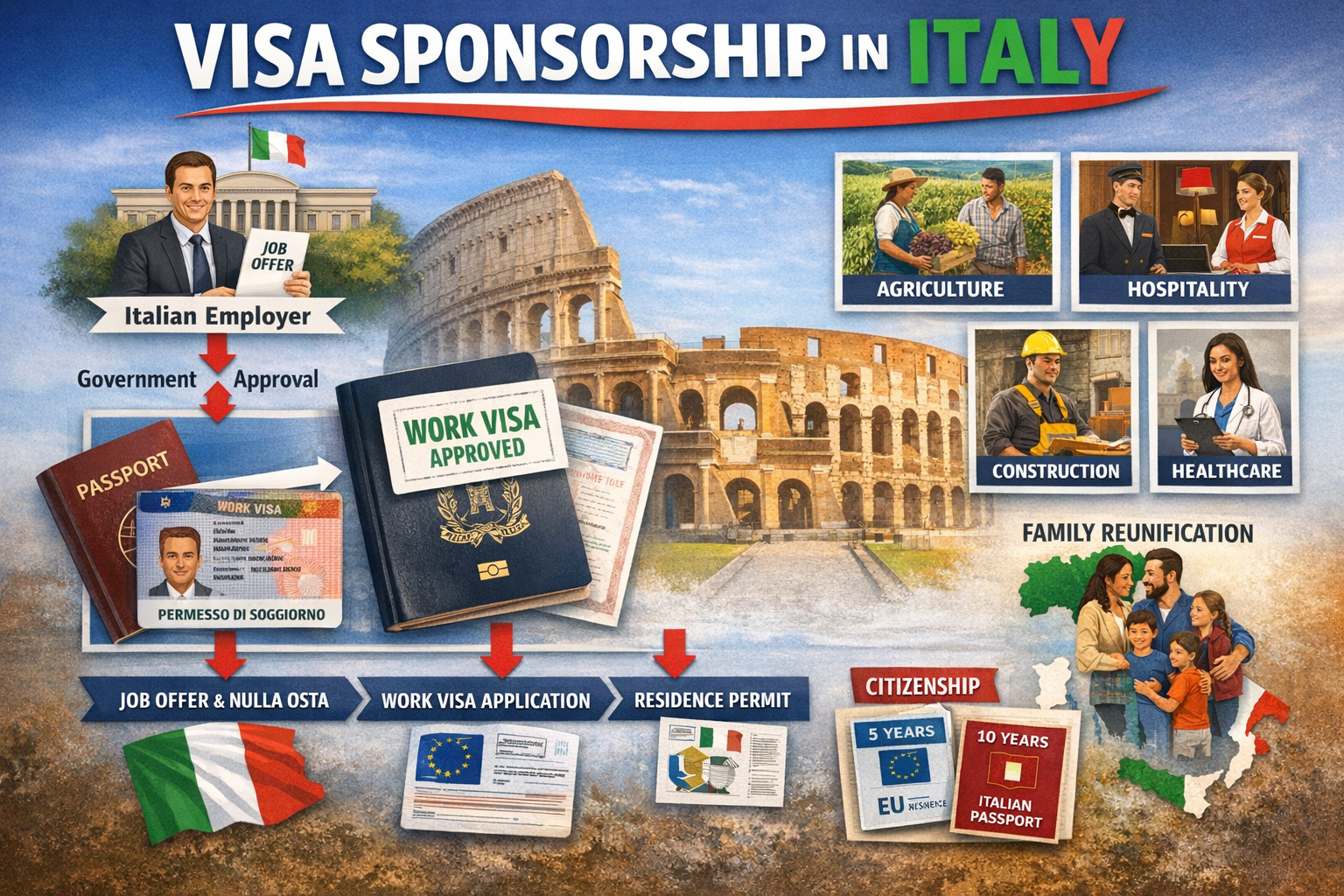
Visa sponsorship in Italy is a structured legal process through which an Italian employer authorizes and supports the entry and employment of a non-EU foreign worker. Unlike many countries where individuals can independently apply for a general work visa, Italy operates under a quota-based immigration system that requires an employer to first secure government authorization before the worker can even apply for a visa. This makes sponsorship the foundation of legal employment for most non-European Union nationals. The system is regulated by national immigration law, annual labor quotas, and regional labor demands. While Italy offers real opportunities in sectors such as agriculture, construction, hospitality, domestic care, healthcare, and specialized professions, the process is documentation-heavy, time-sensitive, and dependent on government quotas known as the Decreto Flussi. Understanding how sponsorship works, what employers must do, what workers must provide, and how residence permits are issued is essential for anyone planning to work legally in Italy.
Understanding Visa Sponsorship in Italy
Visa sponsorship means an Italian employer formally requests permission from the Italian government to hire a specific non-EU worker. The worker cannot apply independently for a standard work visa without this prior authorization.
The legal foundation for work immigration in Italy is based on:
- National immigration law
- Annual labor quota decrees
- Bilateral agreements (in some cases)
- EU regulations for highly skilled migration
For most non-EU citizens, the key requirement is obtaining a Nulla Osta al Lavoro (work authorization clearance).
Who Needs Sponsorship?
You need visa sponsorship if:
- You are not a citizen of the European Union (EU)
- You are not from the European Economic Area (EEA)
- You do not hold long-term EU residence from another member state
EU/EEA citizens can work freely in Italy without a visa.
The Italian Quota System (Decreto Flussi)
Italy controls foreign labor entry through an annual decree called the Decreto Flussi (Flow Decree). Each year, the government sets:
- Total number of foreign workers allowed
- Sectors eligible for foreign hiring
- Seasonal vs non-seasonal quotas
- Country-specific allocations (in some cases)
Applications are processed on a first-come, first-served basis once the quota window opens. When the quota is filled, no additional applications are accepted until the next decree.
This makes timing extremely important. Many applications are submitted within hours of the system opening.
Main Types of Work Visas Requiring Sponsorship
1. Subordinate Employment Visa (Lavoro Subordinato)
This is the standard employee visa for full-time or fixed-term contracts.
It applies to:
- Factory workers
- Construction workers
- Hospitality staff
- Drivers
- Skilled and semi-skilled labor
The employer must prove the job contract is legitimate and compliant with Italian labor laws.
2. Seasonal Work Visa (Lavoro Stagionale)
Seasonal visas are commonly issued for:
- Agriculture (fruit harvesting, vineyards, olive farms)
- Tourism (hotels, resorts, restaurants)
These visas are typically valid for 6–9 months. Workers may reapply in future seasons and can sometimes convert seasonal permits into long-term contracts under certain conditions.
3. EU Blue Card (Highly Skilled Workers)
The EU Blue Card is for university-educated professionals offered high-paying roles.
Requirements generally include:
- Recognized university degree
- Job offer above a salary threshold
- Specialized skills
Common professions include:
- Engineers
- IT professionals
- Doctors
- Architects
- Researchers
The Blue Card offers more stability and potential mobility within the EU.
4. Self-Employment Visa
This applies to:
- Entrepreneurs
- Freelancers
- Investors
- Business owners
It is quota-restricted and requires proof of financial stability and business authorization.
Step-by-Step Sponsorship Process
Step 1: Job Offer
The process begins when an Italian employer offers you a job.
Step 2: Employer Applies for Nulla Osta
The employer submits an online application to the Immigration Desk (Sportello Unico per l’Immigrazione).
Documents required from the employer include:
- Employment contract proposal
- Company registration proof
- Tax compliance records
- Proof of sufficient income
- Housing guarantee for the worker
Step 3: Government Review
Authorities verify:
- Quota availability
- Employer legitimacy
- Labor contract compliance
If approved, the Nulla Osta is issued.
Step 4: Visa Application at Italian Embassy
The worker applies for a work visa at the Italian consulate in their home country.
Required documents typically include:
- Passport (valid at least 6 months)
- Work authorization (Nulla Osta)
- Signed employment contract
- Visa application form
- Passport photographs
- Proof of accommodation
- Educational certificates (if required)
Step 5: Entry into Italy
Once the visa is issued, the worker must enter Italy within the validity period (usually 6 months).
Step 6: Residence Permit (Permesso di Soggiorno)
Within 8 days of arrival, the worker must apply for a residence permit.
The residence permit:
- Legalizes your stay
- Specifies your work type
- Is usually valid for the duration of the employment contract
Without this permit, your stay becomes irregular.
Employer Responsibilities in Sponsorship
The sponsoring employer must:
- Provide a legally binding employment contract
- Pay at least the minimum wage under national labor agreements
- Register the employee with social security (INPS)
- Pay contributions and taxes
- Guarantee housing or confirm suitable accommodation
Failure to comply may result in penalties or criminal charges.
Worker Rights Under Sponsorship
Foreign workers in Italy are protected by labor law and are entitled to:
- Minimum wage protection
- Paid annual leave
- Sick leave
- Workplace safety standards
- Social security benefits
- Access to public healthcare
Your residence permit is tied to your employment, but job changes may be allowed under certain legal conditions.
Processing Times
Typical timelines:
- Nulla Osta approval: 1–3 months
- Visa issuance: 2–6 weeks
- Residence permit processing: Several weeks after arrival
Delays are common due to bureaucracy or high application volume.
Costs Involved
Applicants generally pay:
- Visa application fee
- Residence permit issuance fee
- Administrative tax stamps (Marca da Bollo)
- Travel costs
Employers may sometimes assist with relocation, but it is not mandatory.
Family Reunification
Once you hold a valid residence permit and demonstrate:
- Stable income
- Suitable accommodation
You may apply for family reunification for:
- Spouse
- Minor children
- Dependent parents (under conditions)
Family members receive their own residence permits.
Long-Term Residence and Citizenship
After:
- 5 years of continuous legal stay → You may apply for EU long-term residence.
- 10 years of legal residence → You may apply for Italian citizenship (subject to income, language, and clean criminal record requirements).
Citizenship processing can take several years.
Common Challenges
- Limited annual quotas
- High competition during application window
- Italian language requirements
- Complex bureaucracy
- Risk of fraudulent job offers
Applicants should verify employers carefully and avoid paying illegal recruitment fees.
Key Sectors Hiring Foreign Workers
Italy regularly sponsors foreign workers in:
- Agriculture
- Construction
- Domestic care (caregivers and elderly assistance)
- Hospitality and tourism
- Manufacturing
- Healthcare
- Technology (under Blue Card scheme)
Northern regions generally have higher industrial demand, while southern regions focus more on agriculture and tourism.
Important Practical Advice
- Learn basic Italian before arrival.
- Prepare documents early.
- Monitor Decreto Flussi announcements.
- Ensure employment contract is authentic.
- Keep copies of all documents.
- Never overstay your visa.
Conclusion
Visa sponsorship in Italy is a regulated and quota-controlled process requiring active employer participation and government approval before a foreign worker can legally enter and work in the country. While the system can appear complex due to documentation requirements and annual quotas, it provides a legitimate pathway to employment, long-term residence, and eventually permanent settlement for those who follow the legal procedures correctly. Success depends on securing a genuine job offer, applying during the quota window, submitting accurate documentation, and complying with Italian labor and immigration laws after arrival. For non-EU workers, sponsorship is not optional—it is the essential gateway to working legally in Italy.